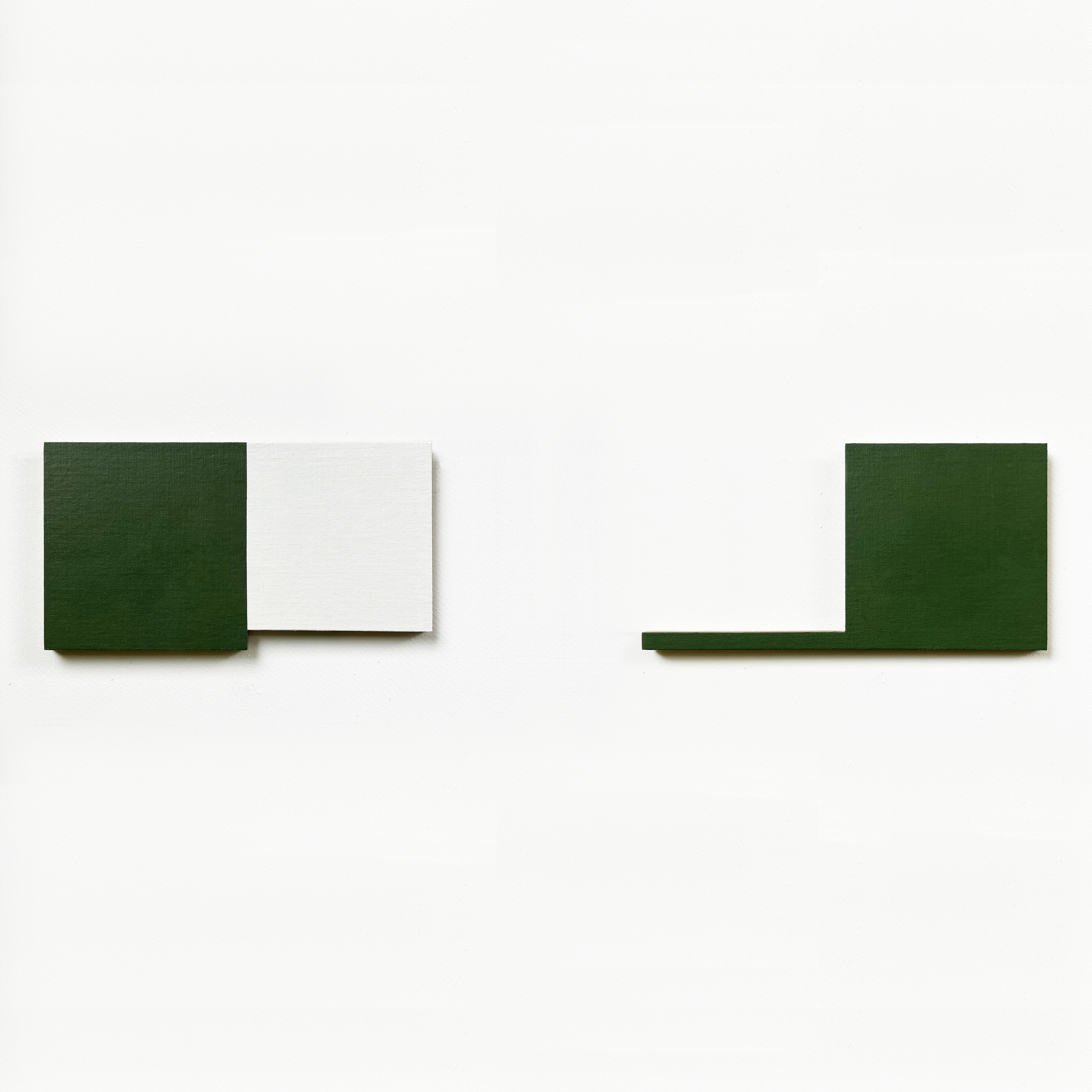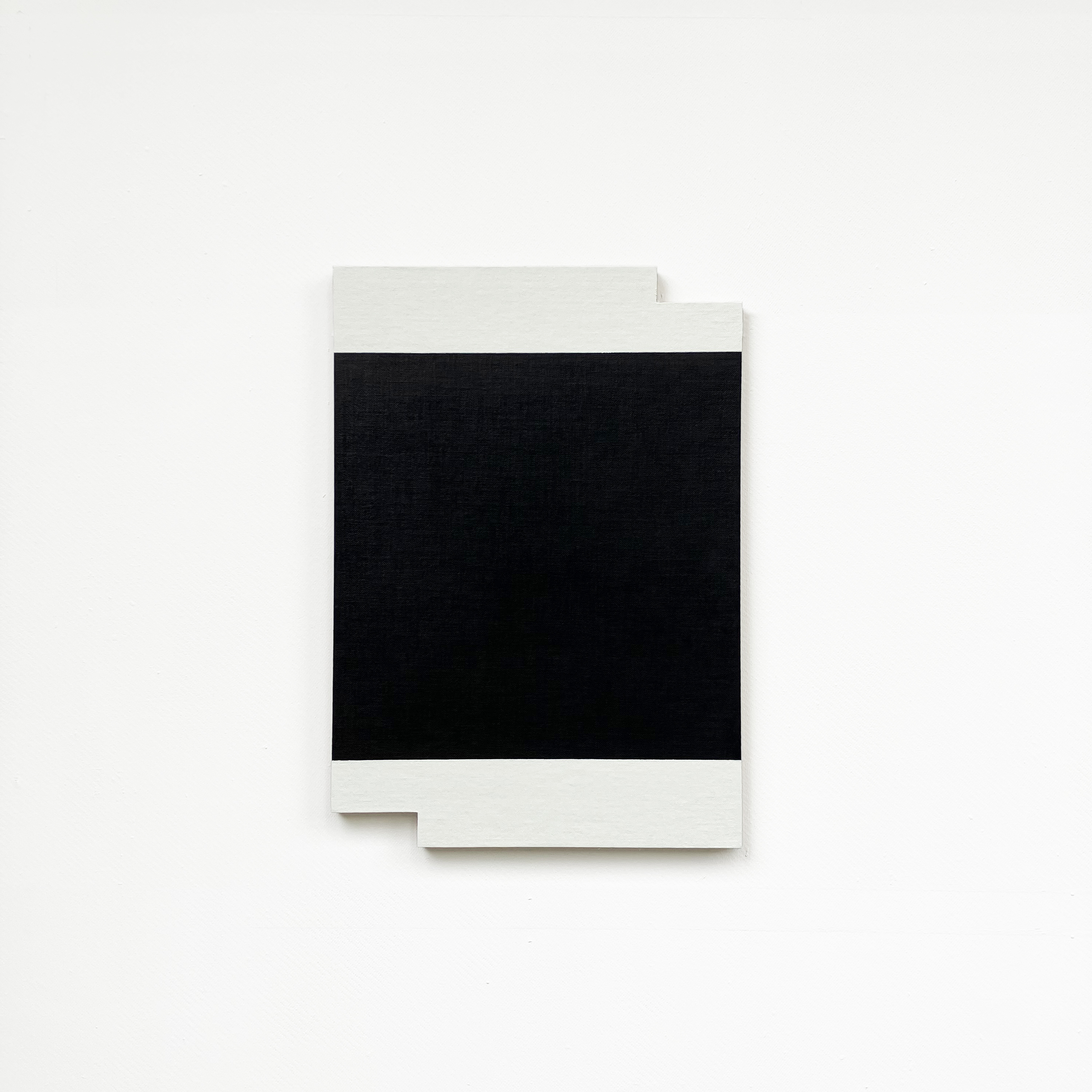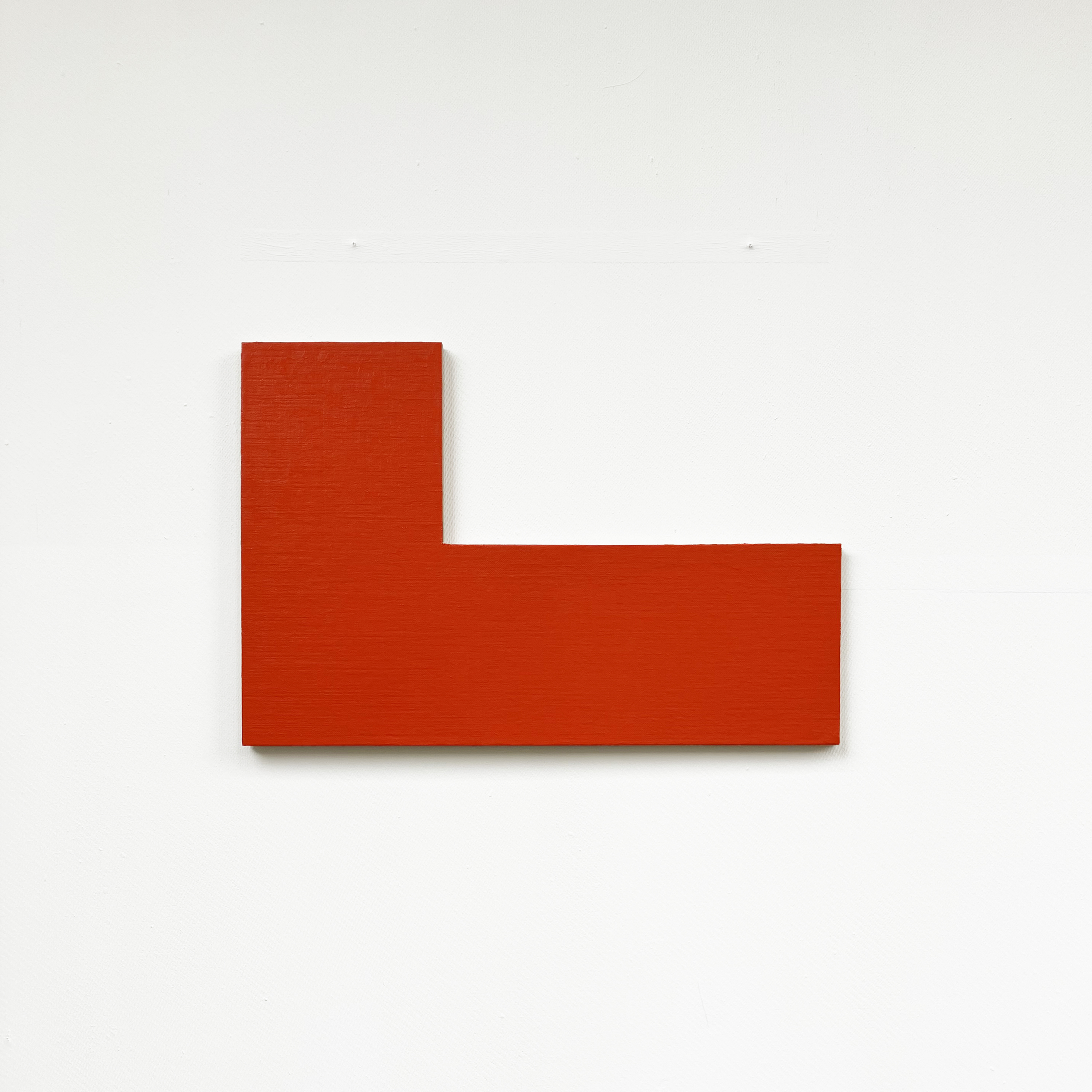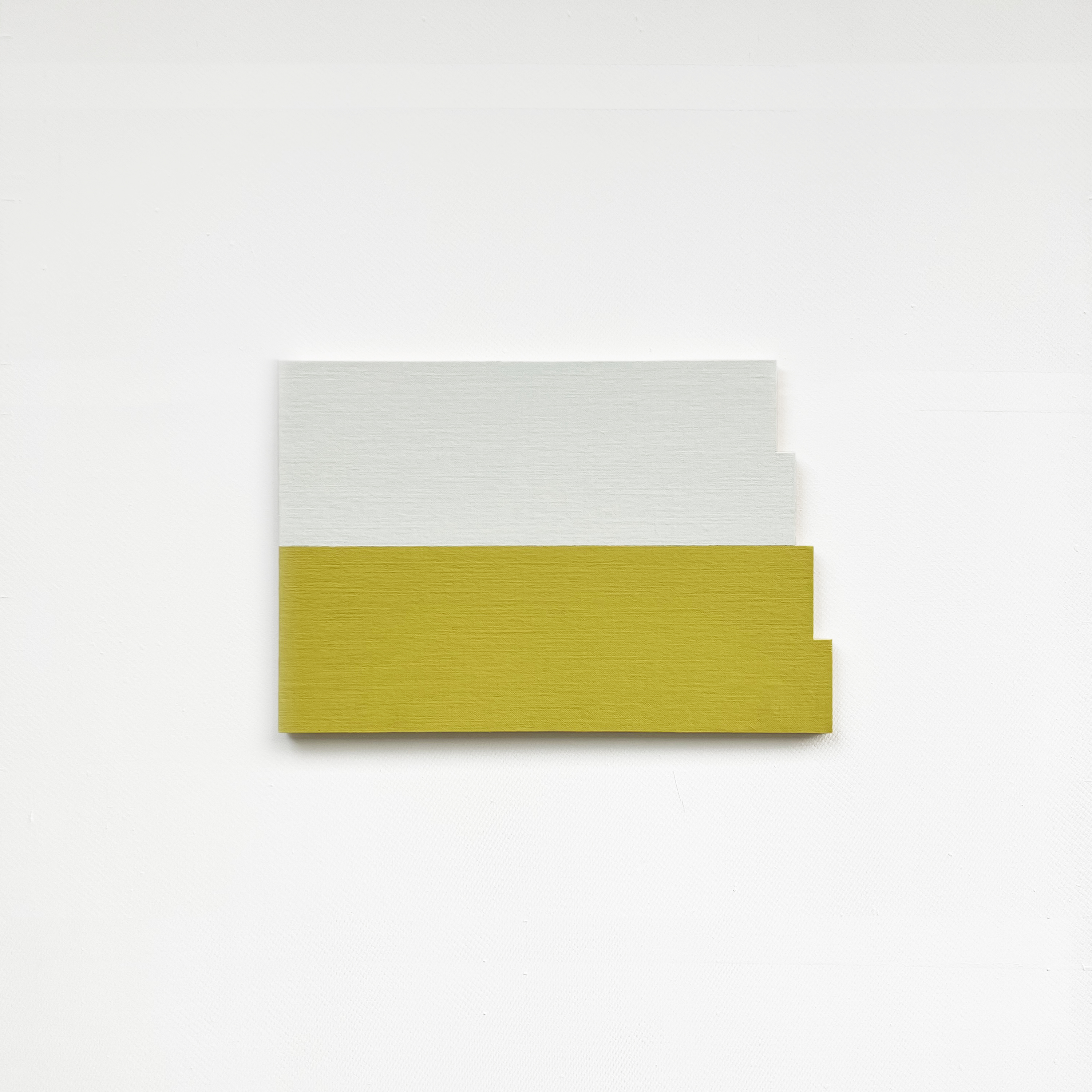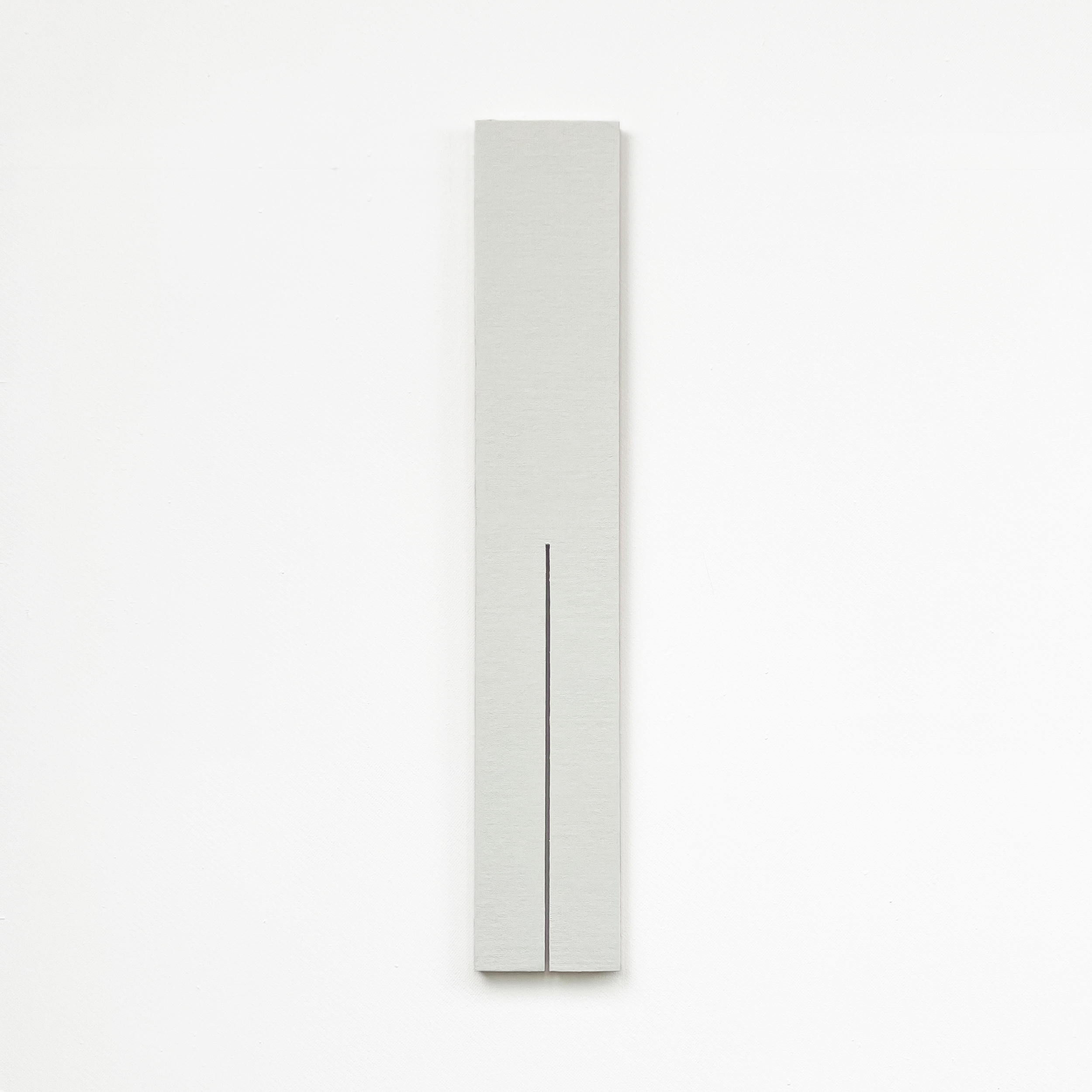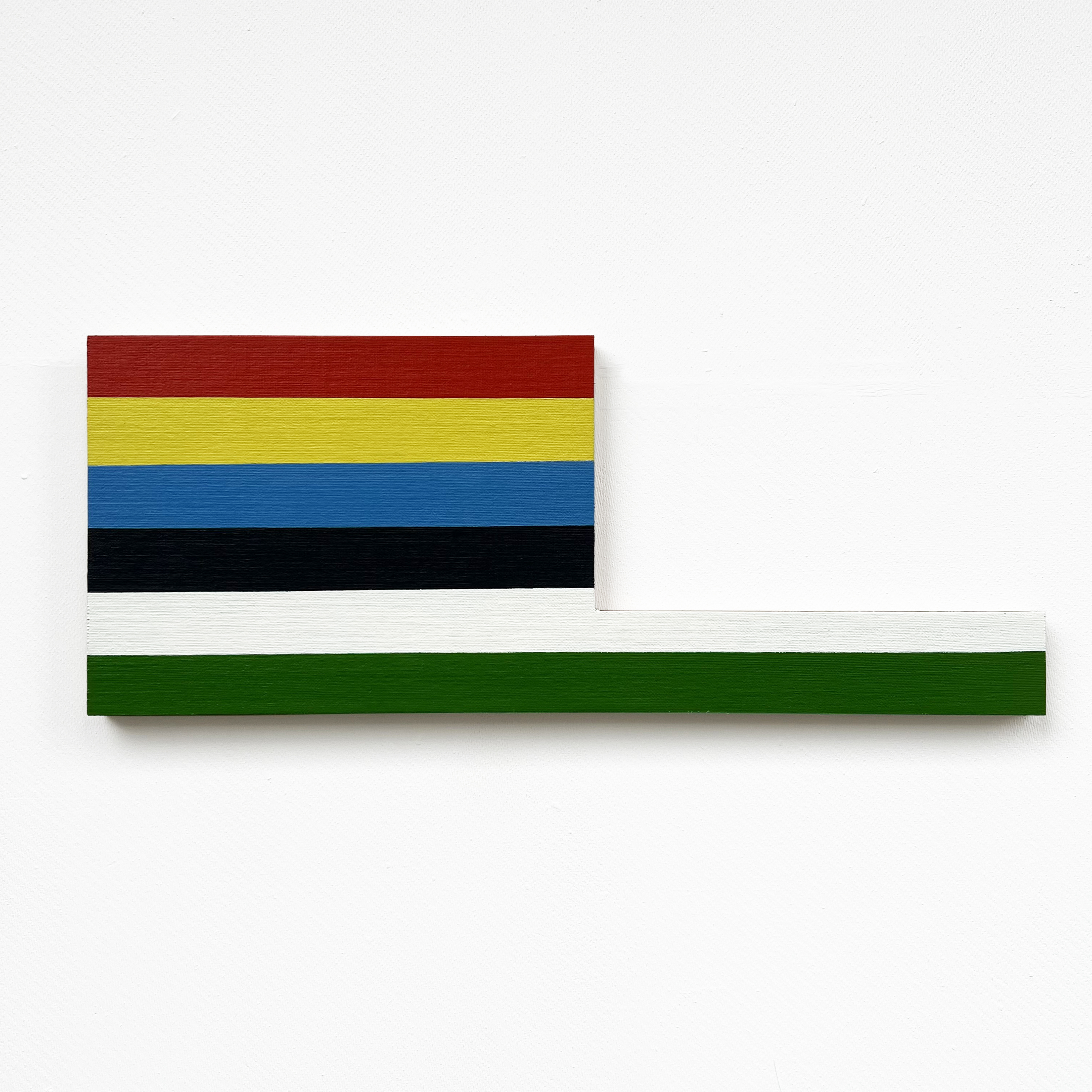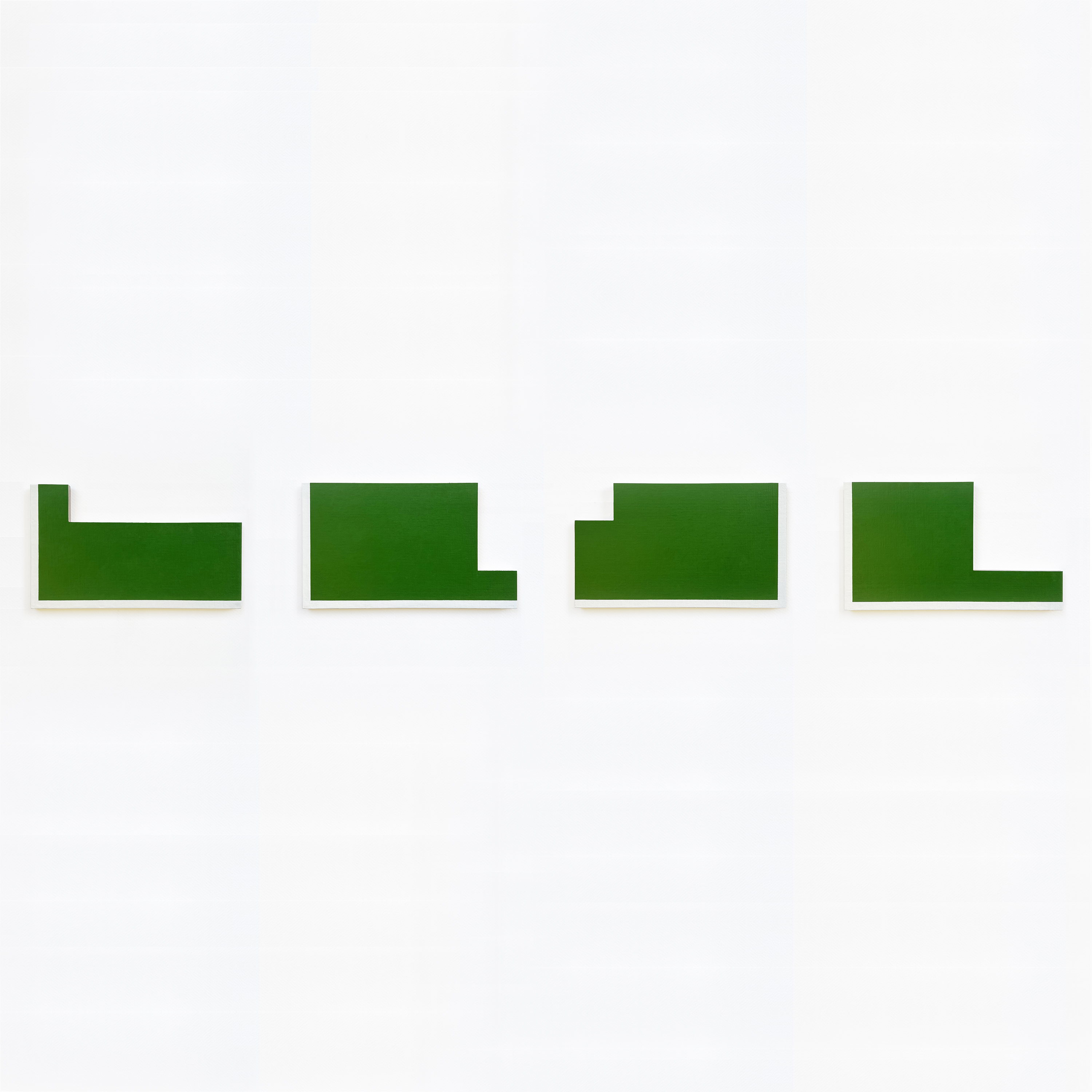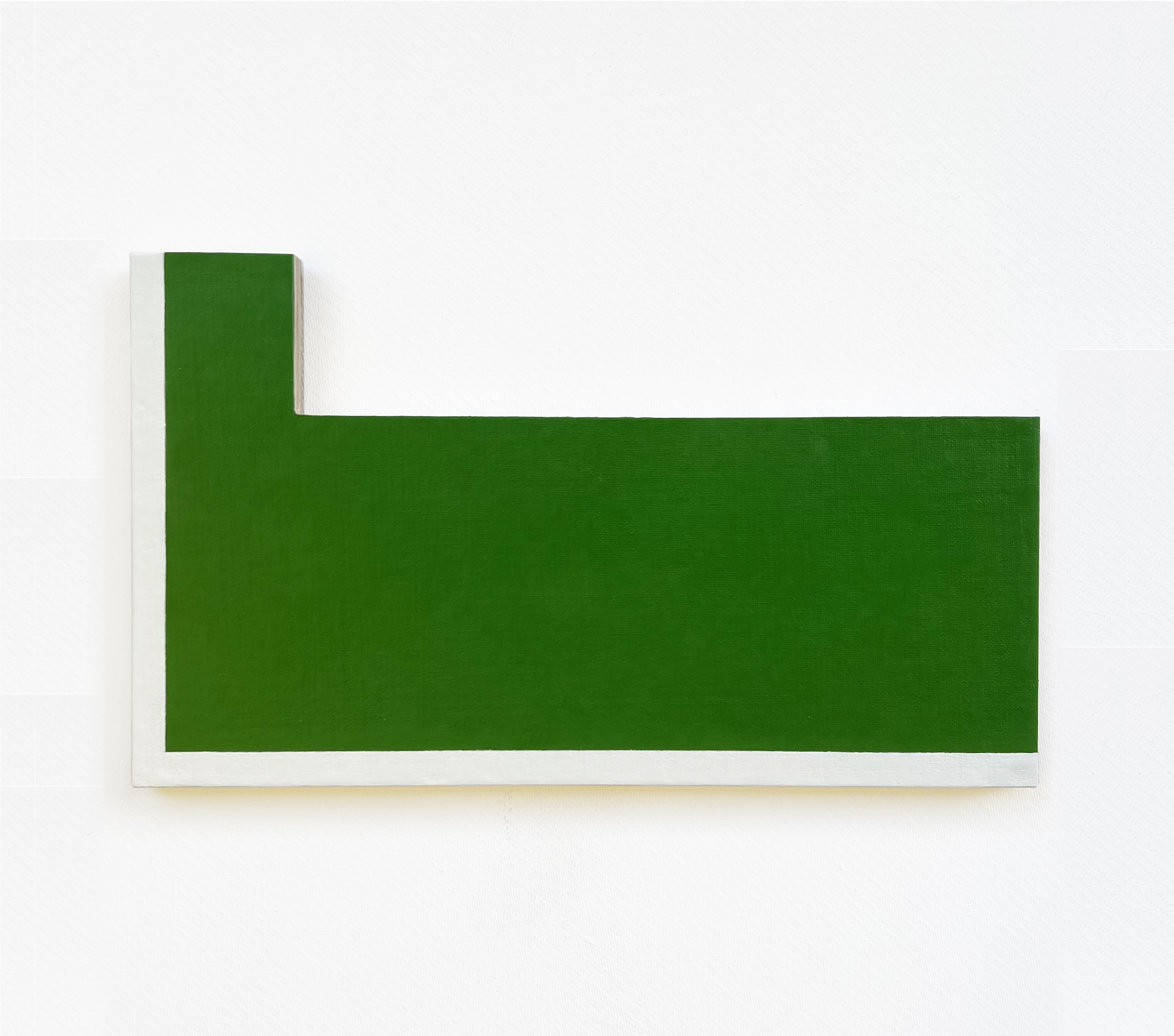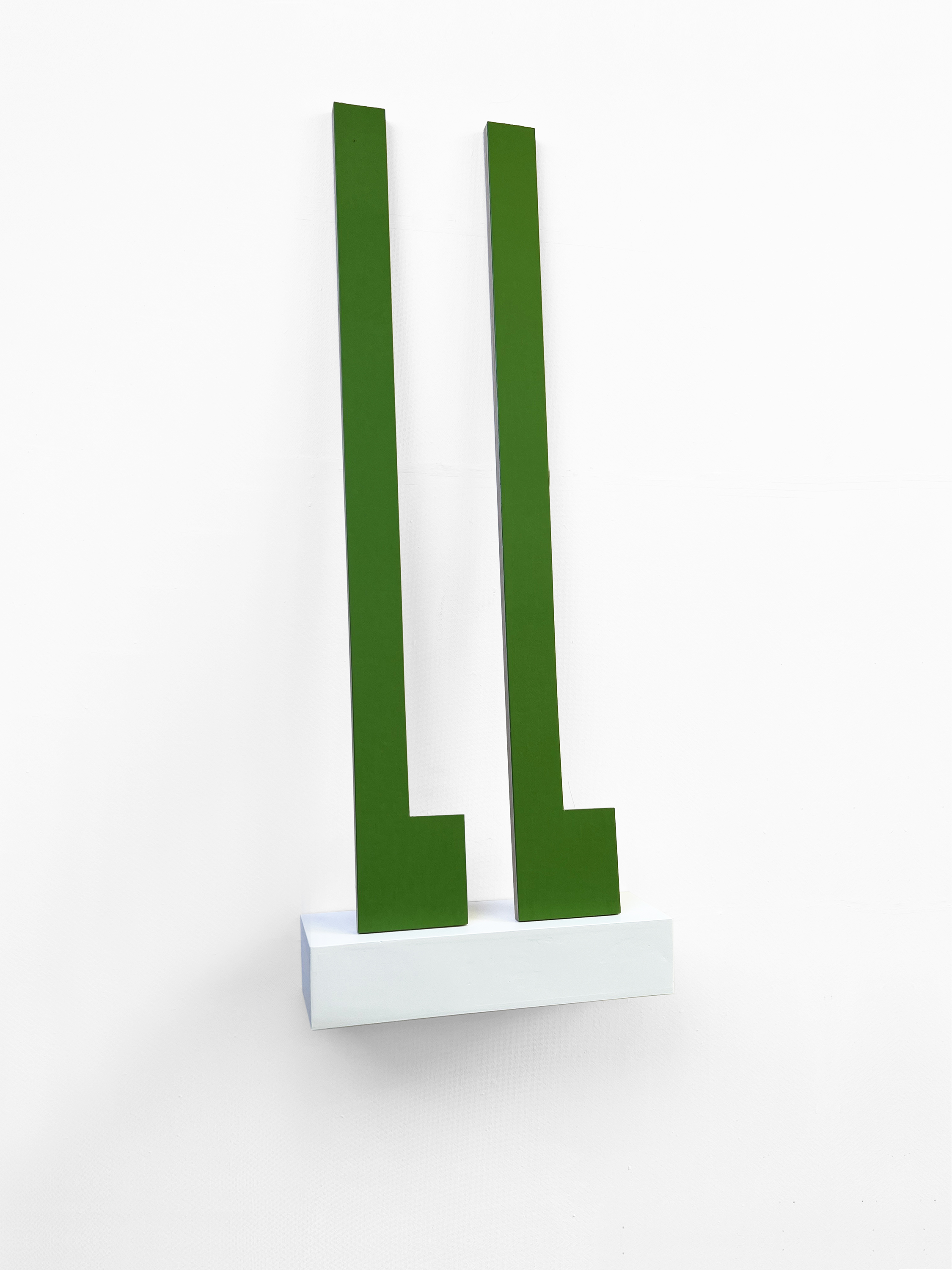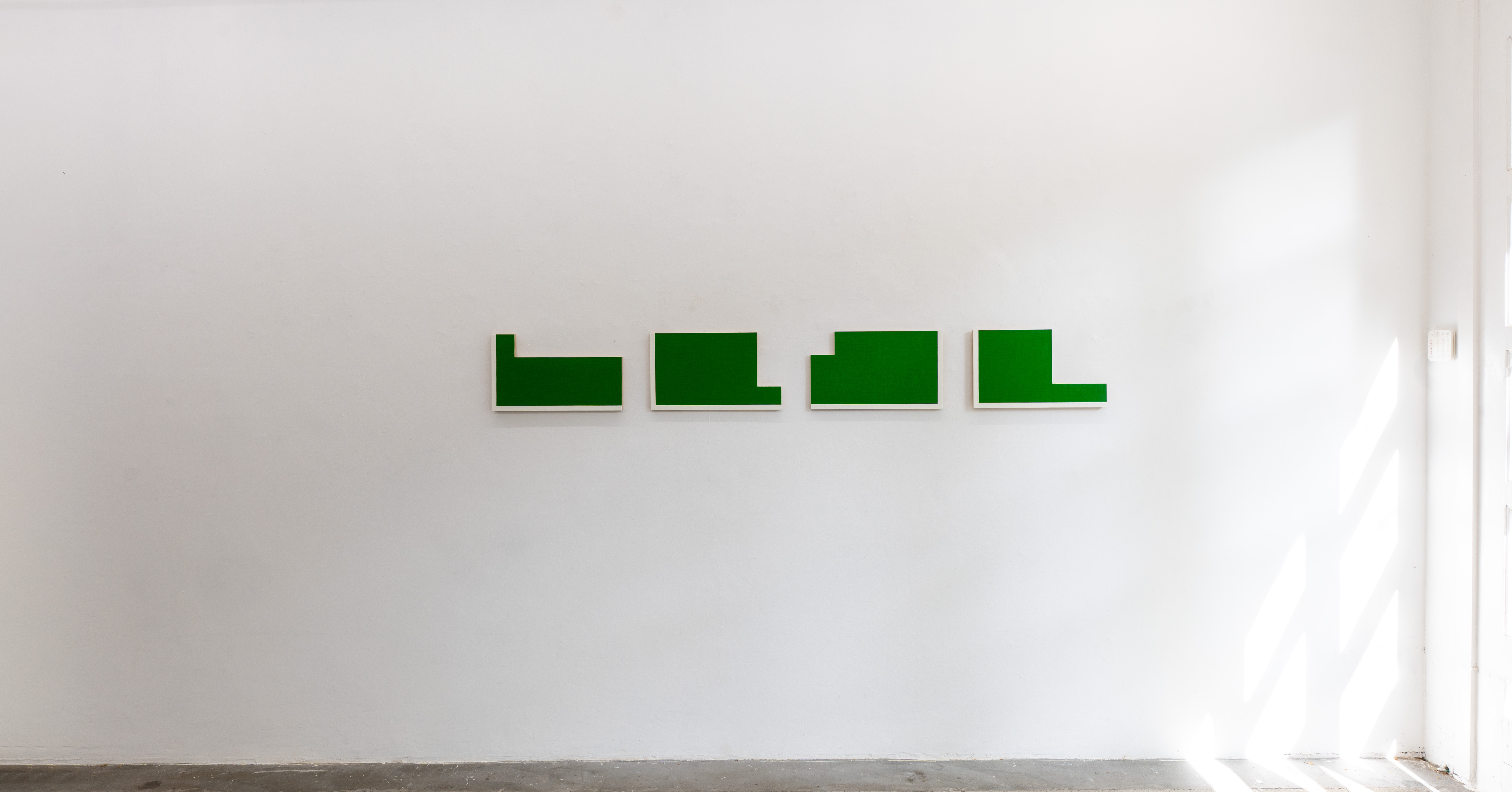
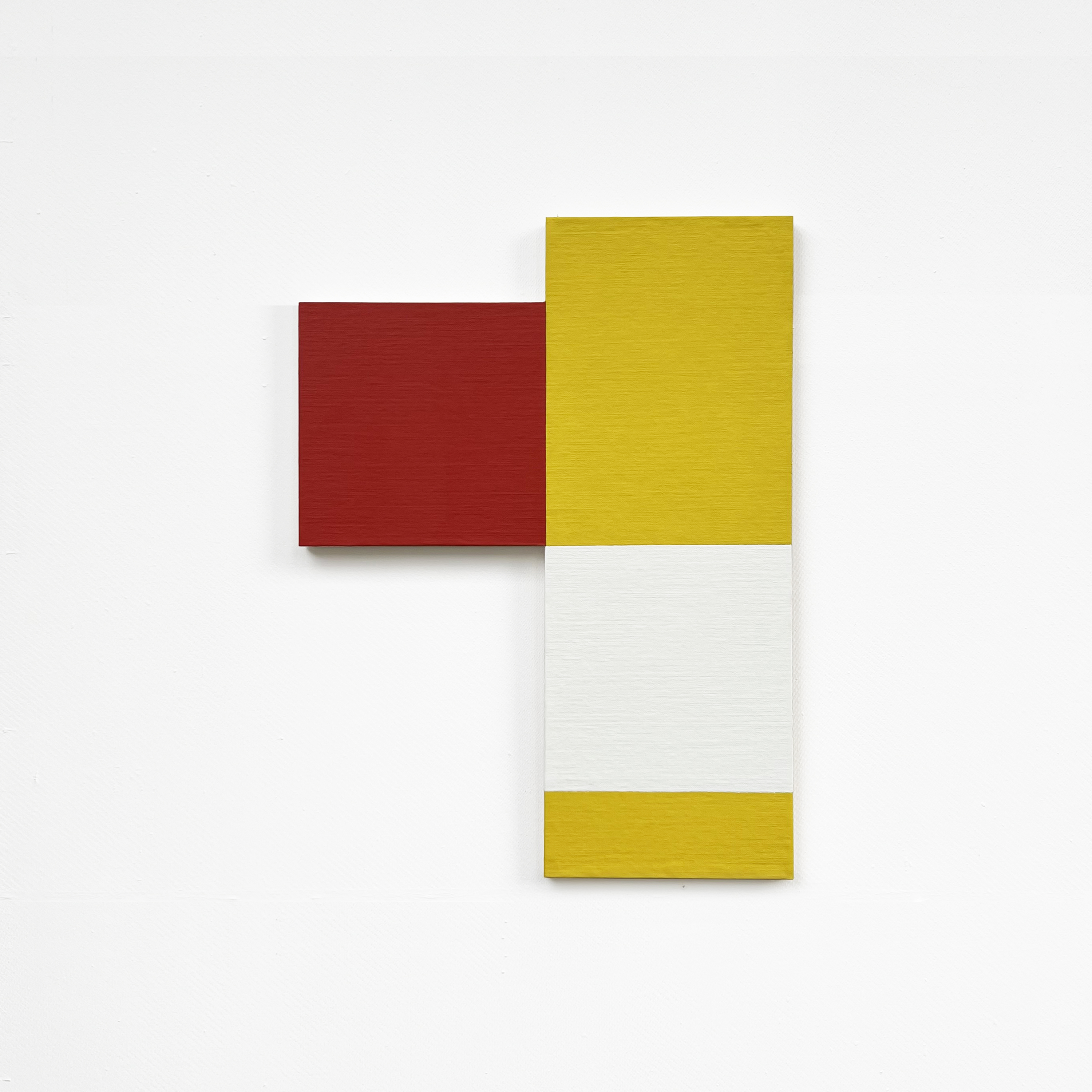
The exhibition Clear-cut works about the cross and other objects, Vunderink’s second solo exhibition with m.simons, comprises some twelve irregularly shaped paintings on canvas. Each work presents a geometric composition in oil paint; most are built from two colors, while others remain monochrome or unfold through multiple hues. Across the exhibition, vertical and horizontal structures repeat with quiet insistence, producing surfaces that appear at once controlled and unstable.
One is tempted to describe these oddly shaped works simply as shaped canvases. Indeed, the shaped canvas occupies an important place within the history of post-war abstraction. Artists such as Frank Stella, Ellsworth Kelly and Blinky Palermo moved away from the traditional rectangle in search of a more essential relationship between painting, object and surface. Within this modernist trajectory, the self-shaped canvas came to signify autonomy: a rejection of illusionism and an insistence on the painting as a literal object rather than a window onto an image.
Vunderink’s works initially seem to operate within this lineage, yet they arrive there through an almost opposite logic. The shapes of the panels were not designed by the artist beforehand, but already existed. The multiplex panels onto which the canvases are mounted originate as offcuts from woodworking projects, residual forms left behind by another process entirely. Vunderink cuts these remnants clean, removing dents, curves and incidental damage while preserving their irregular geometry. What remains are forms composed exclusively of right angles, though never fully regular or resolved.
The resulting paintings are therefore not shaped according to a preconceived compositional system, but emerge from a negotiation with material that precedes the work itself. Rather than imposing form onto matter, Vunderink allows the existing conditions of the material to determine the outer limits of the painting. The works begin not from an empty ground, but from structures already carrying their own history, logic and resistance.
This shift toward allowing material to guide the process has been developing within Vunderink’s practice for some time. During an art fair in 2023, he presented Untitled (Blue Red Yellow), a work in which three canvases each contained one primary color alongside its secondary relations. Rather than selecting colors as fixed compositional elements, Vunderink arrived at them through a prolonged process of adjustment and accumulation. Each hue was built up through repeated layers of oil paint, searching within the material for a precise chromatic balance. Yet every modification destabilized the whole: once a particular red was achieved, the surrounding blues demanded alteration, which in turn affected the purples and greens emerging between them.
Color, in this sense, does not function as a stable visual decision, but as something continually produced through relation. The paintings register not only composition, but duration, a slow process of correction, accumulation and recalibration in which each layer changes the conditions of the next. Surface becomes a record of ongoing negotiation between pigment, absorption, drying time and gesture.
Seen together, the works in Clear-cut works about the cross and other objects propose a form of abstraction rooted less in reduction or purity than in material responsiveness. Their geometry does not emerge from an ideal system imposed onto the world, but from sustained attention to the behavior of matter itself. The paintings become sites where found structures, accumulated color and repeated gestures slowly organize themselves into temporary moments of balance.
Ido Vunderink (Amsterdam, 1955) lives and works in Amsterdam. Since the 1980s he has developed a diverse artistic practice presented extensively in the Netherlands and internationally, across solo exhibitions and group presentations. Vunderink studied at the Gerrit Rietveld Academie in Amsterdam and was part of artists’ collective Seymour Likely from 1988 until 1994.